Enjoy free worldwide shipping on all orders over €59.
Enjoy free worldwide shipping on all orders over €59.

Can the right tongue posture, in other words, “mewing”, change a narrow, elongated face and help with crooked teeth? In this article, we examine the work of Dr. Mike Mew, Dr. John Mew, Dr. Sandra Kahn, and Professor Paul R. Ehrlich.
We can get an answer to why teeth problems, wisdom teeth removal, crooked nose, sunken jaw, mouth breathing, snoring, sleep apnea are so common in our society today.
Never before in history did we experienced such problems at such high rates. What has changed in our environment that so dramatically changed our facial outlook?
In our article you will find answers to the following:
Summary videos about the importance of mewing:
Dr. Mike Mew:
Practical guide for daily mewing habits:

Have you ever noticed that indigenous people’s skulls are nearly always perfect? Wide jawline, no crooked teeth, no elongated head, or a narrow jaw? But after implementing the western diets and customs they also got the same facial development issues.
In the book, Jaws: The Story of a Hidden Epidemic Sandra Kahn, Paul R. Ehrlichey explain this new epidemic called crooked, unattractive face with narrow airways and sleep apnea.
In their book, you can read the detailed scientific explanation.

My summary of the book goes like this: Our modern agricultural system made it possible to consume highly processed, mushy foods which lead to underdeveloped, narrow jaws (too little space for teeth). Furthermore, air pollution and allergies caused stuffy noses which forced kids and adults too to breathe through their mouths. Unnatural tongue posture due to mouthbreathing and fallen chin greatly affect the growth of our face.
We need to reeducate ourselves and learn from our history what causes narrow, sunken jaws and crooked teeth to prevent these problems.
If you want to read another very interesting book, I can highly suggest:
Nutrition and Physical Degeneration by Weston Price. You can download the free PDF here.

Let’s get started
Mewing stands for proper oral posture (how we hold our jaws together at rest) and tongue posture. Its main focus is to help the face to properly develop a nice and wide jaw, straight teeth by changing the position of the resting tongue.
When “mewing”, it is essential that the proper tongue position becomes part of the muscle memory, so that you will get the benefits sooner.
Many people, of course, rest their tongues at the top of their mouths already. However, it is very important how you practice this, as the whole tongue (from beginning to end) needs to rest on the palate (this is its natural position).

On the other hand, bad childhood habits (finger sucking, pacifier, baby bottle instead of breastfeeding, etc.) can easily cause poor tongue posture and improper teeth growth, sunken jaw, which can affect your appearance for the rest of your life.
But there is good news, habits can be changed. Once we learn the natural technique & proper swallowing, proper posture, and nasal breathing we may reverse and change our look for a more attractive and healthier face and may even heal asthma and sleep apnea.
If you want to learn more about nose breathing exercises to eliminate asthma and snoring definitely check out the book: The Oxygen Advantage
It is such a great book for athletes and normal or sick people alike.
“Genetically, very few are born with facial skull disorders. On the other hand, childhood mouth breathing, high air pollution (dust), pasty baby food instead of breastmilk, and other factors negatively affect the development of our facial skull, which is directly related to the increased respiratory disease as airways narrow due to downward jaw growth and increased mouth breathing, which can lead to snoring, low oxygen levels, and sleep apnea. – Dr. Sandra Kahn author of Jaws a hidden epidemic.

Image source: The Cause and Cure of Malocclusion by Prof. John Mew
Keeping the tongue at the bottom of the mouth is a disorder that destabilizes the forces of the lower (mandible) and upper jaw (maxilla). This results in mouth breathing, lengthening of the face, asymmetrical face, reducing the size of the airway, and worse appearance.
Before we get into the details, I need to make it clear that “mewing” is not a new trendy thing to look better right away. Rather, improper tongue posture and mouth breathing will take effect over time. Mewing is simply a correction technique designed to restore tongue and jaw posture.
Dr. Mike Mew is a dentist trained in London and operates his own “orthotropic” (alternative dentistry) clinic there. A third-generation dentist who received his dental training at the University of Aarhus, Denmark, under the mentoring of Professor Birte Melsen. During the 1990s, Dr. Mike Mew was a practicing dentist at the Royal Hospital of London.
Dr. Mike Mew’s father, Dr. John Mew, was granted permission to start the field of orthotropics (meaning correct teeth growth) in 1966. Orthotropics is a branch of medicine that follows the philosophy that the face should be treated, not just the teeth. The field overlaps significantly with the current field of myofunctional therapy, a holistic approach that treats facial and oral disorders. Orthotropics is also represented internationally by the International Federation of Facial Growth Orientation (IAFGG). Over the past decade, the mewing technique has been popularized by his son.
The abnormal growth of the teeth is also due to the wrong posture of the face, neck, jaw, and tongue according to orthotropics. This can be corrected by aligning the rest position of the face, neck, and tongue.
Today, however, bad habits develop more often than before (phone neck, fallen tongue posture, mouth breathing, thumb-sucking, snoring, etc.) which changes the features of our face in the long run.
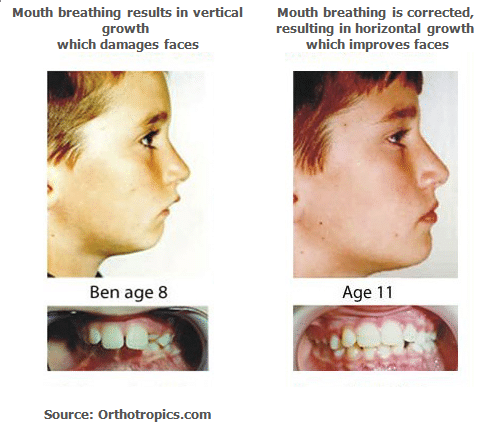
This picture show how mouth breathing can change children’s facial structure.

Image from The Cause and Cure of Malocclusion by Prof. John Mew.
Mewing is about the proper posture of the tongue, neck, and face. Dr. Mike Mew’s basic definition:
“Mewing means resting your entire tongue on the palate until you become unconscious at rest when your mouth is closed.”
Proper posture means that the entire tongue should be at the top of your mouth. This includes the back of the tongue, so the tongue should fit directly between the groin. This can even be tiring at first because the muscles of the tongue are too weak. If you do it right, you should feel some pressure in the middle of your face, chin, jaw, and mouth.
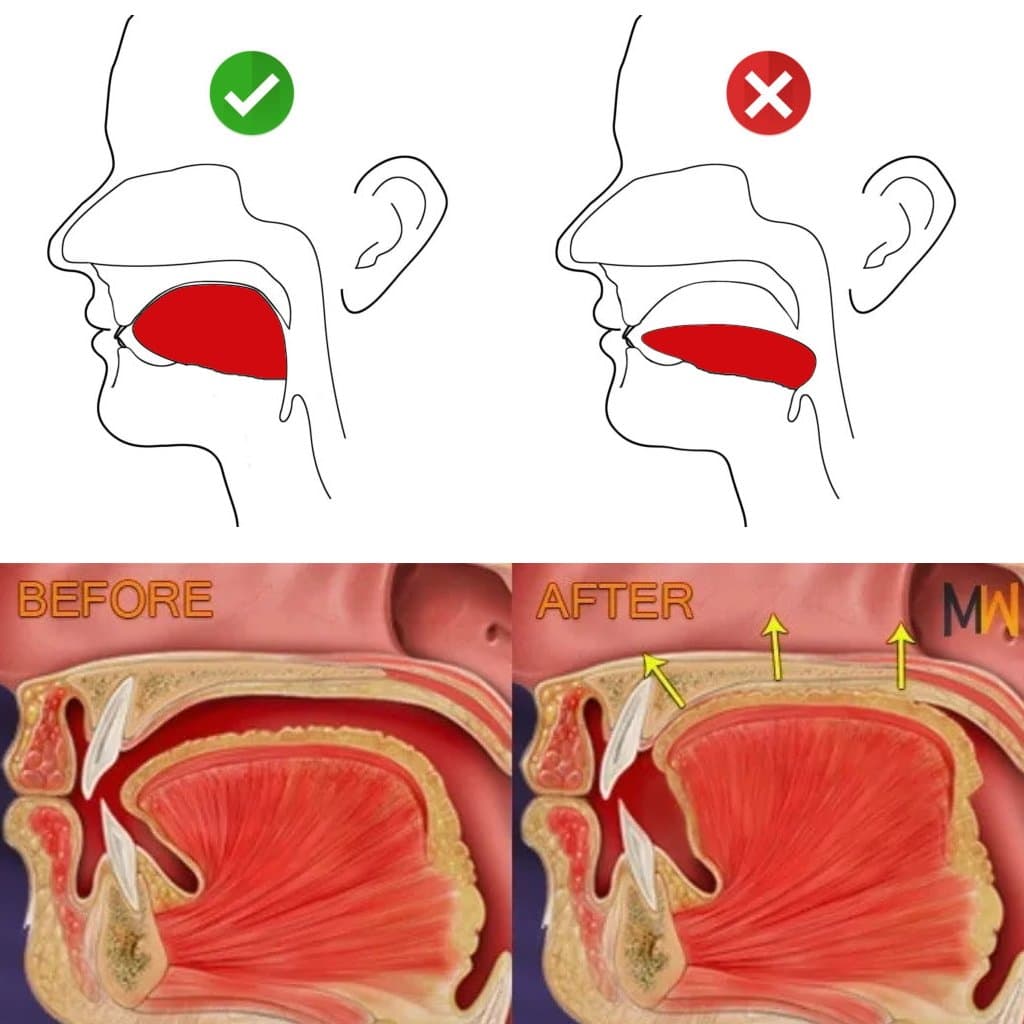
Its effects on the jaw are shown below.
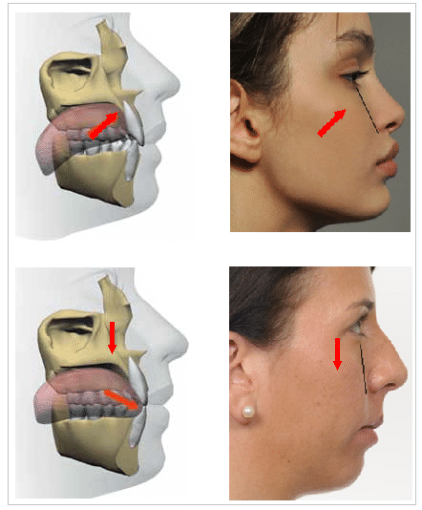
You can see how the resting position of the tongue affects the angle of the face.
Mewing may seem a little strange at first. You need to fundamentally retrain your brain to completely reprogram the resting position of your tongue. Correcting your old habits is not always easy to change, especially if you’ve done it wrong your whole life.
The good news is that after weeks of conscious exercise, your muscles will remember to practice the right posture. This will make it much easier.
In addition to proper tongue posture, swallowing and proper drinking technique are also important. Through the action of swallowing, a force of up to 400g-600g can act on the palate. This force also contributes to the width of the palate (wider jaw) – and ultimately brings noticeable changes in its appearance.
To swallow correctly, simply press your tongue to the top of your mouth while swallowing. Keep your facial expression unchanged, do not move your face. The right thing to do is to feel that your thyroid gland rises with each swallow and your tongue presses against the palate (top) of your mouth.
Note: If you do not hold your tongue properly while swallowing, your development will also be slower. You have to learn to swallow correctly. This is crucial. You don’t even have to overcomplicate, just follow the techniques and feel the pressure all over your palate (from start to finish)

It is important to note that “mewing” should be supplemented with the correct posture. A straight posture should be maintained in both sitting and standing positions. Upright vertical posture is considered a secondary element of the “mewing” technique. The jawline and face should be aligned with the chest. A picture of good posture to better understand:

Because of the simplicity of the mewing technique, don’t overthink it or give up. There are a number of scientific and personal reports that demonstrate its ability to correct facial asymmetry, poorly defined jawlines, overcrowding, crooked teeth.
By training your masticatory (chewing) muscle, you can achieve a stronger, well-defined jaw. Furthermore, chewing promotes proper, forward growth of the lower jaw. The result is a more balanced, raised look, defined jaw, straight dentures.
Last but not least, the airways widen.
Poorly developed jaw narrows the airways, which according to several studies can lead to respiratory disorders such as sleep apnea, snoring, mouth breathing.
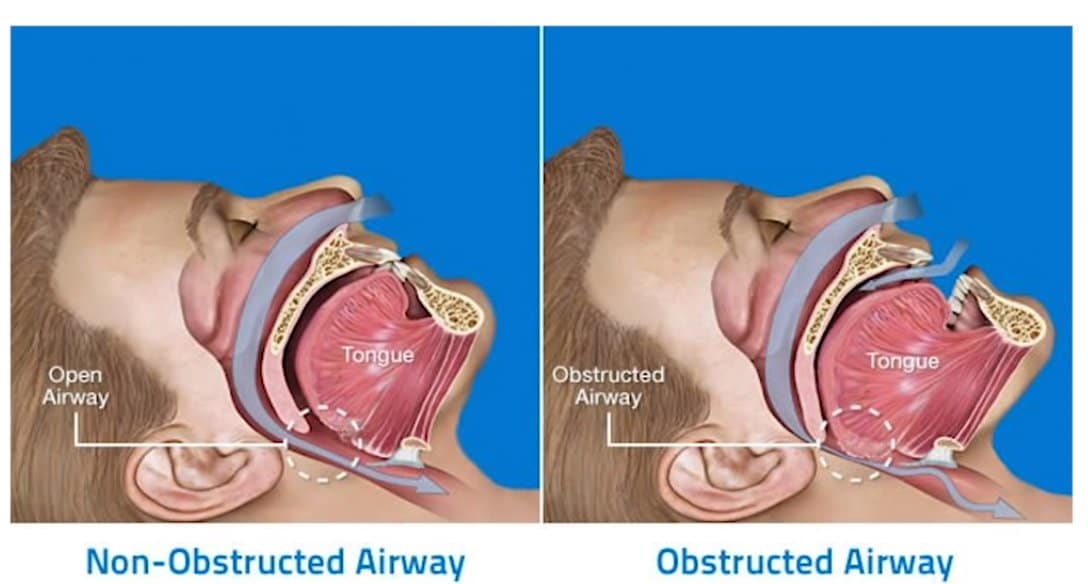
With proper chewing, the tongue moves the food from one side to the other and not the jaw.

Always keep your mouth closed and your posture straight. Do not lean on the plate, but bring the spoon to your mouth. Then, after you chewed the food well 20-25 times, swallow it as you saw it when swallowing saliva.
How to breathe properly- Dangers of mouth breathing😮
Scientific evidence of mewing
So you may ask, what evidence is there to support these claims?
Proper tongue posture is not a new discovery, nor was it invented by Dr. Mike Mew. It has been part of dentistry for over a century. Myofunctional therapy, which teaches patients how to swallow and maintain a proper posture of the tongue, has long been a proven method.
Although few clinical trials have been conducted on the importance of oral posture, we know of the success of even more first-hand cases. However, let us first examine the basic theory of evolution and then look at the evidence.
Contrary to popular belief, the skull is not a big bone. Sutures connect it, in other words, the connective tissues between the skull bones. This means that the skull can change over time.
As an example, Dr. Mew often mentions the motor nervous system disease (amyotrophic lateral sclerosis (ALS)) which has worsened the shape of the skull of physicist Stephen Hawking over time.

Because the muscle did not move due to its condition, its entire skull bent further and further down with age. This indicates that the skull is indeed capable of some flexibility, change (especially at a young age) – which is why it is very important that in childhood, children breathe through their noses, keep their mouths closed, and rest their tongues on the palate, keeping their mouths closed even at night. And also eat hard chewy food such as raw coconut flesh.
Ultimately, the upper jaw (maxilla) is most responsible for the proper development of the face.
With “Mewing,” you put pressure on the maxilla, and that changes your facial look over time.

There is currently little but growing evidence of proper posture of the tongue. Take a look at them and draw your own conclusions. The topic of proper tongue and head posture is unfortunately still largely ignored by mainstream dentistry.
Although existing clinical evidence suggests Mewing as a simple solution, especially for prevention, if applied at a young age.
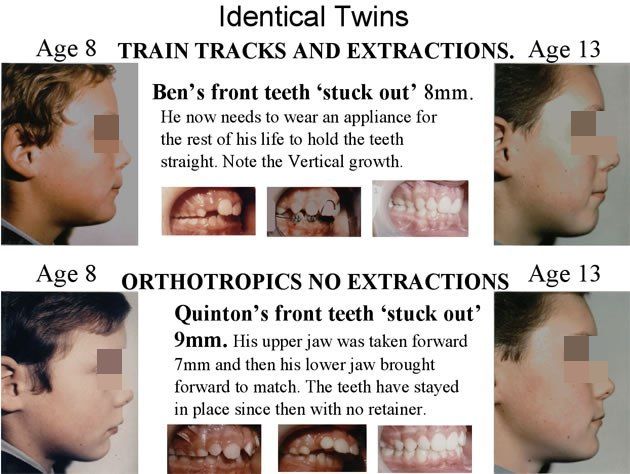
There is still a lot of clinical work to be done on “mewing” and proper oral posture. Some of this information provides us with concrete evidence that the results are successful.
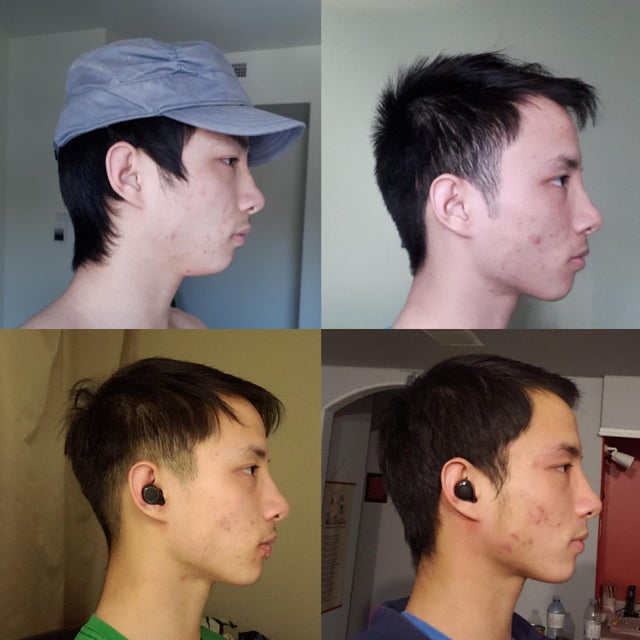
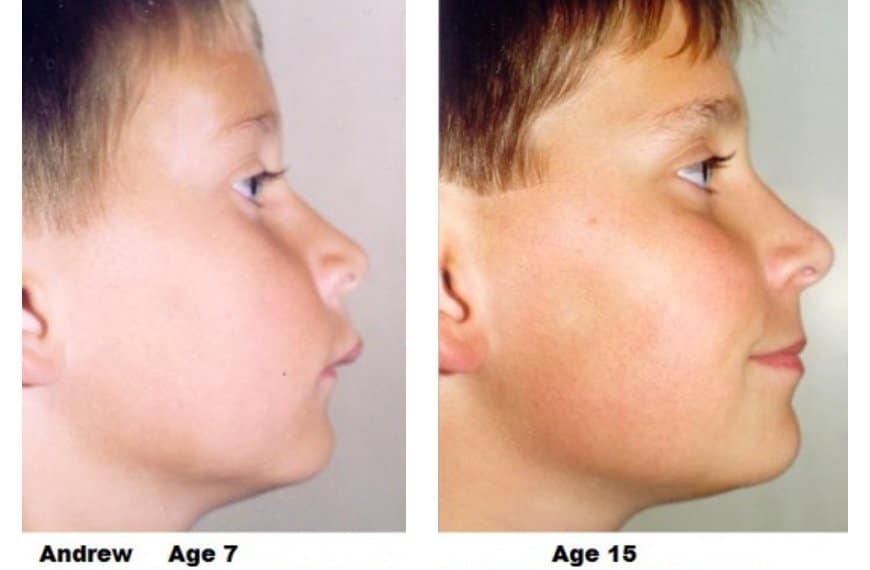
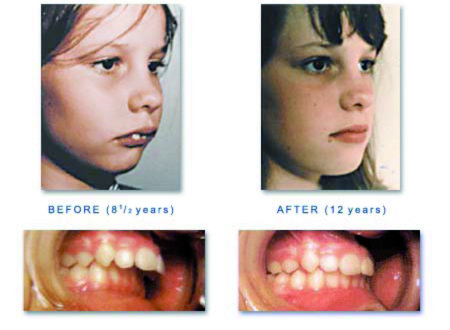
More pictures: http://www.forwardontics.com/gallery.html
These mewing results before and after photos certainly show a noticeable improvement.
When can you expect results?
Since mewing is a corrective therapeutic technique, of course, you will not see immediately visible changes on your face. Many people have reported noticeable changes in the center of the face, jawline, and chin after only 6 months. At the same time, proper posture becomes an unconscious habit after a while (20-30 days) and then you don’t even have to think about it anymore: it will be the resting position of your mouth. The positive effects pay off over time.
Since mewing is based on proper posture and tongue posture and not an invasive surgery, it is by no means a quick fix. Instead, it is a therapeutic correction, which in some cases can take up to a year or more to achieve results. If you correct a bad habit that lasts for several years, it will take time for the changes to show up.
In short: be patient.
Am I too old to start mewing?
It should be noted that mewing affects young faces the most, especially children under puberty. With the mewing technique, some change can be achieved in adults as well, but more slowly. This is because the face is much more flexible at a young age (the skull bones are less rigid).
Dr. Mike Mew also practices mewing and you can see it in his appearance, even though he started mewing as an adult.
Could our modern lifestyle be the cause of small jaws & recessed chin?
Dr. Sandra Kahn is a dentist and Paul R. Ehrlich is a professor of biology at Stanford University
In their book: Jaw is a story of a hidden epidemic. They report, among other things, why there is no skull problems in tribal people.
Tooth decay and wisdom tooth extraction, as well as a sunken, narrow jaw, are a consequence of our modern lifestyle (mouth breathing, soft, pasty foods, lack of chewing, baby bottle, pacifier, high levels of air pollution).
Dr. Weston A. Price (1870-1948) was a world-renowned dentist who toured the earth and visited natural, uncivilized peoples and observed that they had no tooth and jaw problems.
Furthermore, the diseases of our time: cancer, diabetes, thyroid diseases are not found in them either.
There is plenty of evidence mentioned in his book for those who want to read more about the topic:
Nutrition and Physical Degeneration – book available for free here: http://gutenberg.net.au/ebooks02/0200251h.html
Yes, chewing gum as a substitute for chewing is also highly recommended by Dr. Mike Mew and Orthotropics. Make sure it is sugar-free and does not contain artificial sweeteners (aspartame, sucralose, etc.) The natural chewing gum made in Greece called Mastich is considered to be the best. Which gives our chewing muscles a lot of work.
Q. Can I chew multiple chews at once for faster jaw strengthening and better results?
A. Yes, it is even recommended. The “mewing” community suggests 2 types:
1. Falim gum (Turkish sugar-free chewing mastic)
2. Masticha crystals or masticha chews (even more natural, even better)
Steeljawlinegum makes original Greek mastic gums, and they ship worldwide. Their gum is natural and sugarfree!
For those with a fairly narrow palate or seriously crowded, ill-aligned teeth (“malocclusion”), positioning the tongue on the top of the mouth may be difficult in the beginning because their tongue does not fit in. In this case, you may want to consult with a dentist to install a palate expander until your tongue fits comfortably on the palate.
Bests palate expanders according to orthotropics
Proper daytime mewing maintenance will be automatic at night as well.
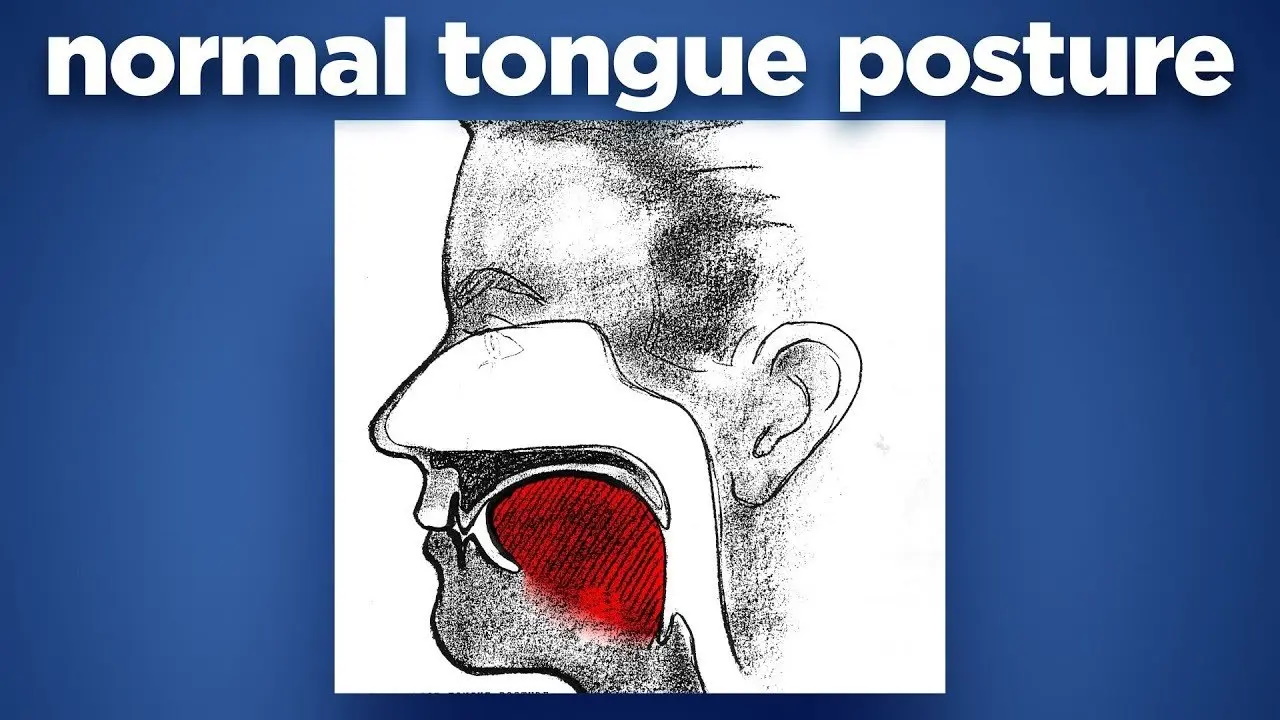
Here is a picture about normal tongue posture:
It is crucial not to sleep on your back. Sleeping o the sides or tummy helps to keep your tongue from falling to the bottom of your mouth. Taping your mouth is a very effective method against snoring and mouth breathing at night
Here is a picture to better understand

Here is a video of proper posture while sleeping.

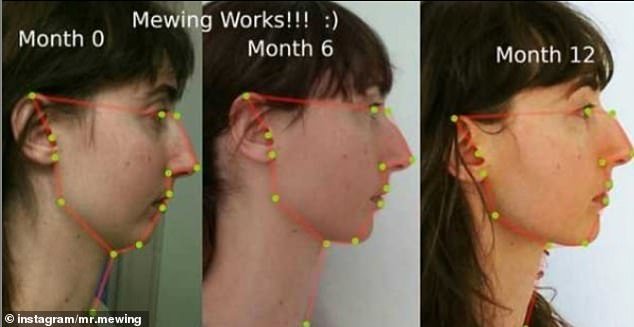

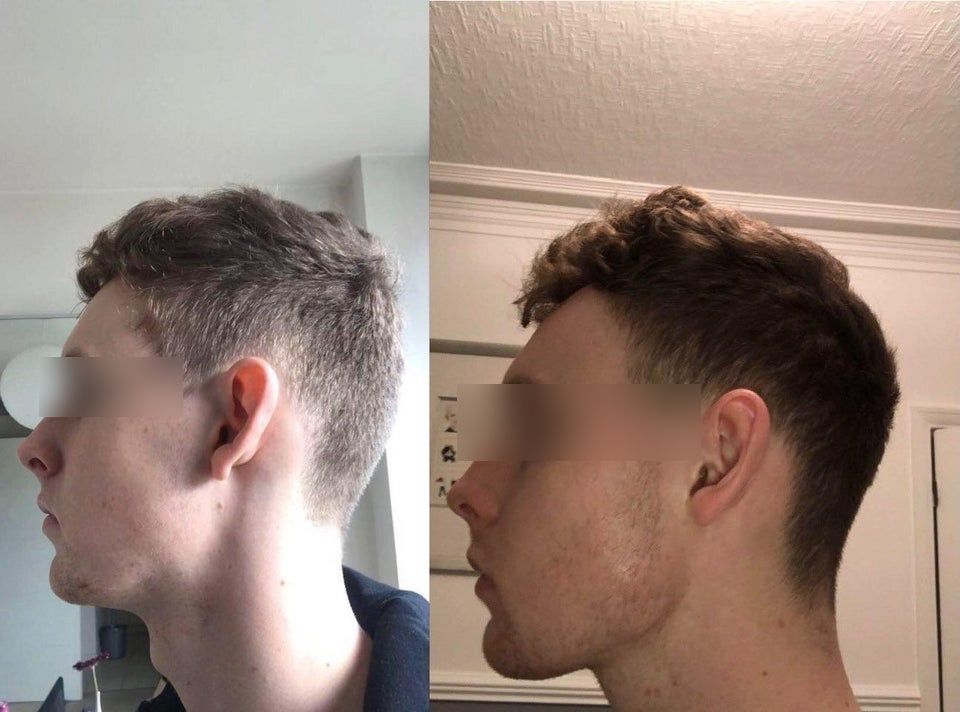



The human body’s development continues throughout our lives, but those early years when the organs and skeletons of infants and toddlers are rapidly growing and forming are particularly crucial. At this juncture, breastfeeding plays an especially important role. During breastfeeding, the infant has to intensely use their jaw and mouth, which strengthens developing muscles and stimulates the correct growth of the jaw and dentition.
Breastfeeding is a natural way for infants to learn proper mouth posture and tongue usage, which later aids in proper facial and jaw development. This natural practice helps prevent developmental abnormalities in the dentition and jaw, such as teeth crowding, narrow jaw, and elongated face.
Unlike with a bottle or pacifier, during breastfeeding, infants actually have to suck the breast milk, which strengthens the jaw muscles. This contributes to the proper development of the jaw and dentition, as well as promoting correct tongue posture and the development of swallowing techniques.
Therefore, breastfeeding is not only an important part of an infant’s nutrition but also forms a fundamental part of facial and jaw development. So, if possible, it’s worth favoring breastfeeding over bottle feeding for the sake of long-term facial and jaw development





Good
The connection between a beautiful face and straight teeth is indeed a fascinating one. This article highlights the importance of dental health in overall facial aesthetics. Thanks for sharing this intriguing insight!